“Sooner or later, everything old is new again.” — Stephen King
In the modern era, we take the “voice” of the fan for granted. We live in a world where “Swifties” wield enough economic power to shift the GDP of small countries, and where Spotify algorithms know our musical tastes better than our spouses do.
But to understand how the audience became the ultimate influencer, we have to look back to a time when the listener was silent, and the industry “expert” was king.
The Era of the “Golden Ear”
The music business of the late 20th century was a street-smart, high-octane, but remarkably information-poor industry. Decisions worth millions of dollars were not made based on data, but on bravado, intuition, and the legendary “golden ears” of A&R executives.
In this “wild west” environment, market research was virtually nonexistent. Record labels tracked manufacturing numbers and top-line sales histories, but that was autopsy work—it told you what had already happened, not what would happen.
Defining the “Fanaticus”
The industry had forgotten the true definition of the “fan.” As we know, the word is short for “fanatic.” It stems from the Latin fanaticus, meaning “inspired by a deity” or “frenzied,” originally referring to religious zealotry.
The industry saw consumers; the future saw fanatics. The question was: Could that zealotry be measured?
The Epiphany on Sunset Boulevard
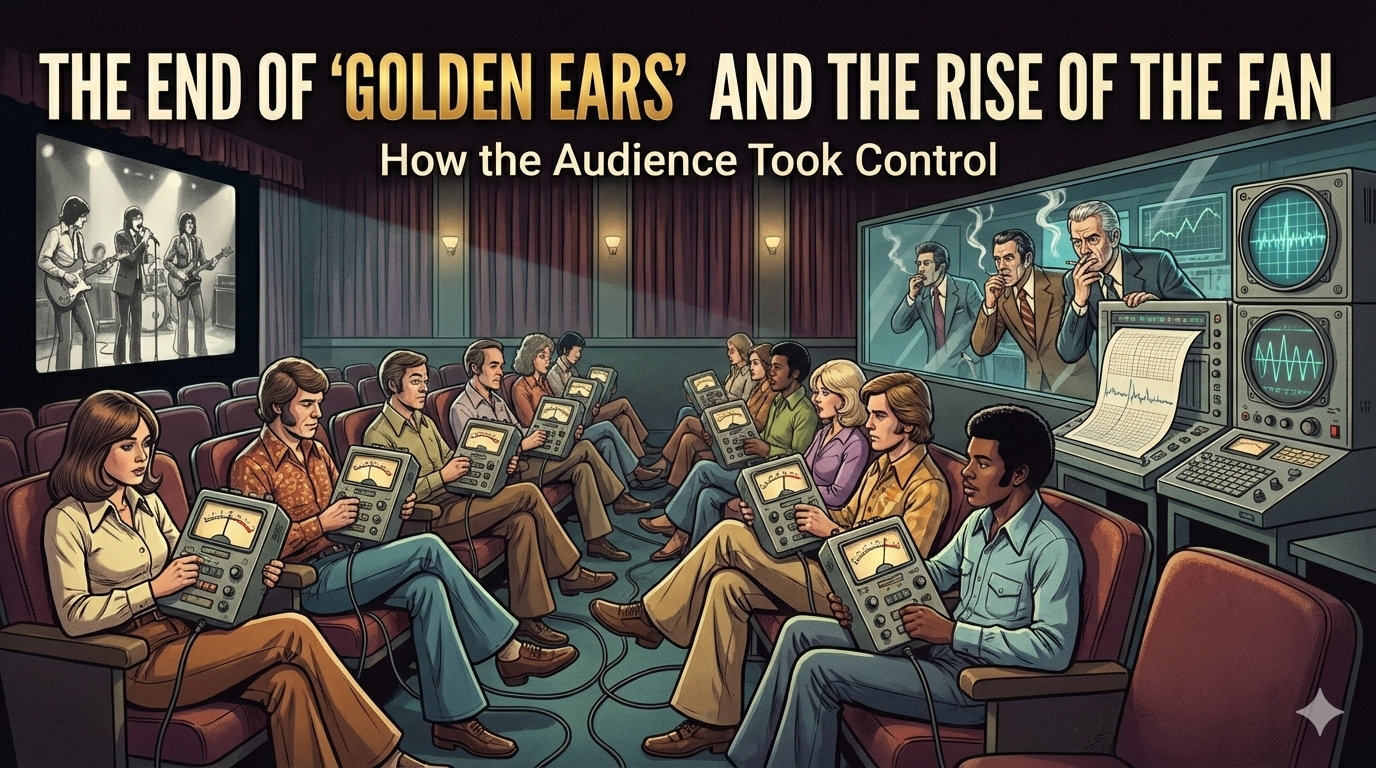
The crack in the old philosophy appeared in June of 1974. Larry Heller, a young, long-haired music executive with a background in progressive music, found himself sitting in a media-testing lab on Sunset Boulevard in Hollywood. The facility was the Preview House, the headquarters of Audience Studies Inc. (ASI), a company that pre-tested movies and TV pilots.
Heller sat in the dark, his fingers resting on a dial device. As he watched the screen, he turned the dial to register his interest in real-time. It was a simple mechanical action, but it triggered a radical, heretical thought:
“We can do this with records!”
The Changing Landscape
The timing was critical. The “Bubble Gum” pop era was fading, and radio playlists were tightening. The industry was fragmenting into complex sub-genres: FM progressive rock was rising to challenge the dominance of AM Top 40. The old tricks were failing. Too many songs promoted as “hits” were dying on the vine, and listeners were tuning out due to excessive repetition.
Heller reasoned that intuition was no longer enough. The industry needed to bring the “voice” of the audience into the boardroom before a commercial release. This wasn’t just about avoiding flops; it was about determining if a song had the potential to create that “inspired” connection with the listener.
It was a move to democratize the sound of popular culture, though the industry didn’t know it yet.
Sign up for our email list below to get notified on the release of Chapter 2: “1974—The Laboratory on Sunset Boulevard”